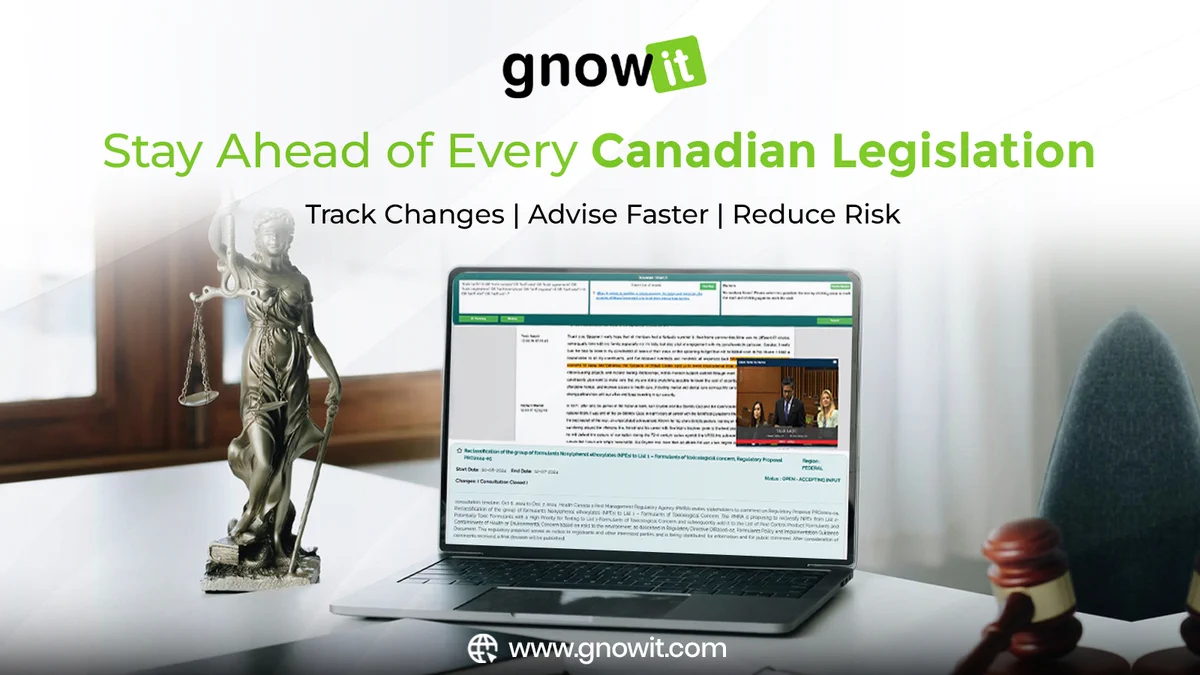


Most Canadian GR and public affairs teams have a federal monitoring process that works. The failure point is almost never Ottawa. It is the provincial gazette that nobody caught, the OSFI supervisory letter that arrived between the annual guideline updates, the committee study that concluded while the team was focused on a federal budget cycle. Regulatory change tracking is not about whether your team is paying attention. It is about whether your infrastructure covers the full surface area of where Canadian regulatory change actually originates.
The organizations consistently ahead of the policy curve are not better staffed or better connected. They have monitoring that covers the complete regulatory lifecycle, from Order Paper signals and committee study announcements through Gazette Part I consultations to finalized agency guidance, across every jurisdiction relevant to their files, delivered at the moment of publication rather than through secondary discovery.
Gnowit’s legislative monitoring platform automates this across federal Parliament, all provincial and territorial legislatures, regulatory gazettes, and 700+ municipalities. What follows is where the gaps in manual regulatory change tracking consistently appear, what comprehensive coverage requires, and why the current Parliament makes the infrastructure question more consequential than it has been in years.
Where the Gaps in Regulatory Change Tracking Actually Are
The conventional assumption is that monitoring gaps reflect resource constraints. In practice, the organizations with the most significant gaps are often those with capable, experienced teams who are simply covering too much ground manually. The failure is structural, not professional.

The Provincial and Regulatory Gazette Layer
Legislative activity generates media coverage that creates a secondary discovery safety net. An OIC filing in Alberta, a gazette notice from the AMF, a departmental operational bulletin from a provincial securities regulator, these move through the primary record without generating the coverage that would surface them through normal monitoring channels.
For organizations with cross-jurisdictional regulatory exposure, this is where the most consequential gaps sit. Canada Gazette Part I at the federal level is reasonably well-monitored by most GR teams. The provincial equivalents, each published independently on its own province’s gazette, separate from the federal Canada Gazette, are where Part I consultation windows routinely close before affected organizations are aware they opened.
Agency Communications Between Formal Guideline Releases
The published guideline is not the complete picture of OSFI’s supervisory expectations. The supplementary letters, FAQ updates, speeches, and risk outlook publications that sit between formal guideline revisions are where OSFI signals how it is applying rules in practice, and where examination priorities are set. Teams monitoring at the guideline level are systematically missing the layer of regulatory intelligence that shapes how compliance functions are actually assessed.
The same applies to FINTRAC interpretation notices, CSA staff notices, and departmental operational bulletins. These publications arrive without advance notice and without the media attention that accompanies formal releases. Monitoring infrastructure that covers only formal gazette publications is covering less than half of the regulatory signal that affects most Canadian organizations.
Committee Intelligence Before Reports Are Tabled
By the time a standing committee tables its report, the positions are set. The productive window, when witness testimony is still shaping committee direction, when member questioning lines reveal where the government is heading, when amendments are still being considered, exists during the study, not after it concludes. Committee monitoring that delivers same-day transcript access during active studies is a materially different intelligence product from monitoring that surfaces committee outputs after publication.
The Workload-Pressure Correlation
Manual regulatory change tracking fails most reliably when internal teams are under the most pressure, federal budget periods, regulatory examination cycles, parliamentary sitting weeks with accelerated committee schedules. Regulatory agencies publish continuously regardless of internal workloads. The cost of monitoring gaps is highest precisely when monitoring consistency is hardest to maintain.
The organizations that track regulatory change most reliably are not the most disciplined. They are the ones whose monitoring infrastructure runs regardless of what else is happening internally.
Manual Monitoring vs. Gnowit: Regulatory Change Tracking Across Key Dimensions

The operational difference between manual regulatory change tracking and Gnowit’s automated monitoring is most visible at the dimension level:
| Capability | Manual | Gnowit |
| Regulatory source discovery | Periodic checks, gaps between reviews | Continuous scan, alerted on publication day |
| Canada Gazette Part I | Caught late, consultation window compressed | Delivered within minutes, full comment period intact |
| Provincial regulatory changes | Contact or media dependent, inconsistent | All 10 provinces monitored in real time |
| OSFI / FINTRAC guidance | Email subscription, variable and delayed | Matched alert on publication across all document types |
| Committee signals | Reviewed after report is tabled | Same-day transcripts, any committee, any jurisdiction |
| Consultation deadlines | Manual calendar, high error risk | Automated open/close alerts per file |
| Historical record | No systematic record | Searchable archive with publication timestamps |
| Bill tracking | Tracked jurisdiction by jurisdiction across separate registries, stage changes easy to miss | Tracked from introduction to Royal Assent across all jurisdictions, automated stage-change alerts |
| Cross-jurisdictional visibility | Federal only or fragmented | Unified federal, provincial, and municipal coverage |
| Internal escalation speed | Hours to days | Minutes, routed to the relevant team member |
The pattern across every dimension is the same. Manual processes deliver intelligence after the relevant window has partially or fully closed. Gnowit’s regulatory change tracking delivers it at the moment of publication.
What Comprehensive Regulatory Change Tracking Requires
Configuration Around Regulatory Accountability, Not Topics
Monitoring configured around broad topical keywords generates volume without actionable precision. Effective regulatory change tracking is scoped to the specific legislative frameworks, committee mandates, agency publications, and jurisdictions that map directly to the organization’s regulatory accountability structure.
Full Jurisdictional Scope by Default
Federal-only regulatory change tracking is tracking less than half the relevant landscape for most Canadian organizations. Provincial regulatory changes in energy, financial services, infrastructure, and environmental assessment consistently precede federal movement. Municipal decisions on procurement and land use carry direct compliance and operational implications for organizations with local footprints.
Gnowit covers federal Parliament, all 10 provincial legislatures, 3 territorial assemblies, and 700+ municipalities through a single configuration, replacing the fragmented jurisdiction-by-jurisdiction processes that characterize most manual monitoring programs.
Connected to the Workflows That Drive Response
Monitoring that identifies a development without triggering an internal response has no operational value. The KPIs that measure monitoring effectiveness, time from publication to internal awareness, consultation participation rate, proportion of developments discovered through primary versus secondary channels, improve when regulatory change tracking feeds directly into the triage, briefing, and change management workflows that convert intelligence into decisions.
Regulatory Change Tracking in the Current Parliament
The 45th Parliament is generating regulatory activity across trade policy, energy transition, housing, interprovincial competitiveness, and financial sector modernization simultaneously. With this volume of activity moving simultaneously, the window between a parliamentary signal and a finalized regulatory position is often measured in weeks, not months, the exact gap that manual monitoring struggles to close.
Regulatory Change Tracking as a Competitive Intelligence Function
The compliance framing of regulatory change tracking captures the minimum value it provides. For GR and public affairs teams, every Gazette Part I publication, every committee study announcement, and every ministerial statement signalling a policy shift is an engagement opportunity, a window to submit comments, appear as witnesses, brief officials, or coordinate with industry partners before positions harden.

The organizations that consistently engage regulatory processes at the right stage are doing so because their monitoring infrastructure finds developments while engagement is still possible. That is the operational function that Gnowit’s regulatory change tracking is designed to serve: not the compliance record, but the strategic advantage that comes from knowing first.
Regulatory change tracking is not a compliance function that happens to benefit GR teams. It is a strategic intelligence function that happens to have compliance applications. The organizations that treat it as the latter consistently get more value from it.
Canada’s regulatory environment, 13 jurisdictions, a minority Parliament operating at pace, and a federal regulatory calendar running in parallel with active provincial agendas, requires monitoring infrastructure that matches its actual scope and speed. Gnowit provides regulatory change tracking across this full landscape in real time, delivering matched intelligence at the point where it can still change what GR and compliance teams do next.
Book a 20-minute conversation with Shahzad Khan to see it configured against your specific files: calendly.com/gnowit-sk/30min
Related Reading
How Legislative Alerts Automation Improves Policy Intelligence
Canada Gazette Part I vs Part II: What Each Means for Compliance
Automated Regulatory Monitoring in Canada: A Plain-English Guide
Consultations Tracker: Never Miss a Window to Comment
Same-Day Transcripts vs. Official Releases: Why Timeliness Wins
Committee Intelligence: Tracking Witnesses, Motions, and Amendments
Bill Tracking in Canada: Federal, Provincial, and Territorial in One Workflow
How to Build a Legislative Monitoring Executive Brief That Leaders Actually Read
How Legislative Monitoring Software Can Enhance Your Advocacy Efforts
KPIs for Government Relations Dashboards: Measuring What Matters Most